3 Squadron RAAF
STORIES
3 Squadron RAAF HOME / Search
3rd Squadron AFC HISTORY -
1918.
SHOT DOWN!
"I think it will be all right..."
A
letter published by The Cumberland Argus and Fruitgrowers
Advocate (Parramatta, NSW), 6 Jul 1918:

The
young Parramatta birdman, Lieut. Aubrey REES, tells, in
an interesting letter home, of his fight over the Australian front in
the battle line in France, and how he came fluttering to earth, to get
into hospital, and to get a trip to "Blighty."
"Three
machines went up in formation — my pal (Lieut. Love), Simpson and
myself. [11th
April 1918.]
We
had finished our job, and were on our way home when we sighted our 'Archies'
[Anti-Aircraft
guns] firing
at something up over Amiens. The three of us kept going in this
direction, keeping an eye on where the 'Archies' were bursting.
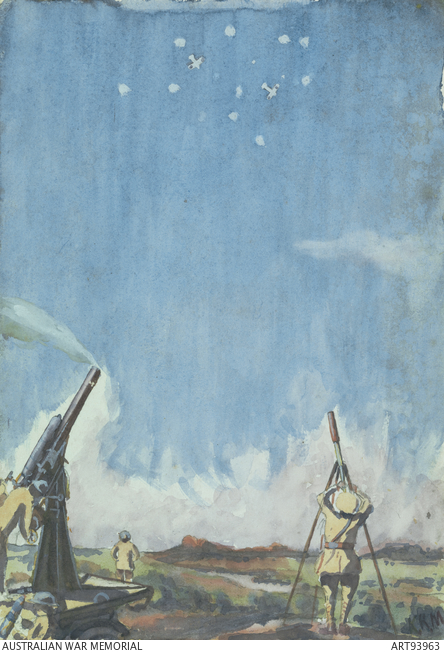
An anti-aircraft gun is trained skyward onto enemy aircraft. A
soldier watches the enemy aircraft through a telescope.
The Allied 'Archie' generally burst with WHITE smoke, the German
equivalent was BLACK,
giving pilots in the air excellent clues as to the origin and location
of the aircraft being fired at!
[AWM. Artist: Kenneth MacQUEEN,
1917-18.]
Suddenly
I heard about a dozen machineguns; and I saw six Huns working
around on my tail!
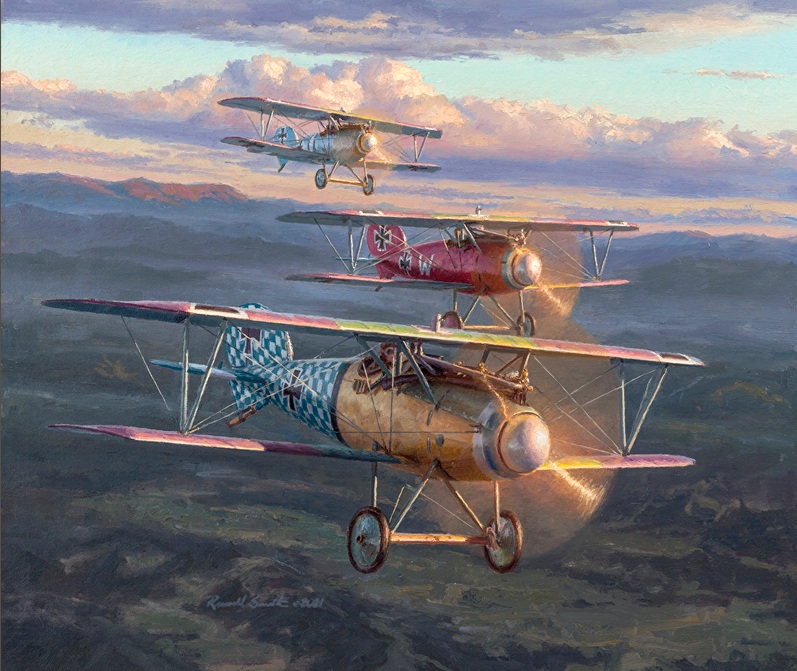
A frightening view of Albatros DV.a fighters from 'Royal
Barvarian' Jasta 76b.
3AFC's Rees & Paul were claimed by Js76b's Uffz DIEM, who
would have been flying a plane with similar markings to the third one in
line. The personalised red Alabatros, flown by Vzfw. Siegfried
WALTHER, was also noted on that day. The group of Js76b
Albatroses appear to have then gone on to attack another RE8 from
RAF XV (15) Squadron , which managed to shoot down two of them, before
being itself forced down. The crew of that RE8 (Hart & Handford)
were both awarded Military Crosses for their feat!
[Artwork by Russell SMITH.]
My
two mates had their noses down, hopping it for their lives,
and I would have followed them 'tout suite,' only the Huns, being
nearly twice as fast as I was, one cut me off, so I had to get into
their necks.
But,
as bad luck would have it, their second burst carried my
control clean away, and all I had left was the rudder-bar.
With only this left I would have been able to glide down and land
safely, provided I kept straight. But that would have been
fatal, as they were sitting on my tail like one o'clock.
To
dodge this, I put on left rudder, and she immediately went into a
left-hand spin. The Huns followed us down, firing at us,
but they could not get a sight on us, as we were spinning. When
the Huns stopped firing I tried to pull her out of the spin, so
applied opposite rudder. She soon came out of a left-hand spin
and into a right-hand!
After
this, things were very fogged.
-
But I know I stuck to her to the finish, with my Observer [Lt. G.
A. PAUL] hanging over my shoulder, saying ‘Stick to it,
Bluey! She'll come out of it!' I sort of remember
her stop spinning; saw the ground very close...
The
next thing I know was (48 hours after) in a Casualty Clearing
Station [No.5 CCS Tincourt], a nurse saying, 'Here,
wake up; drink this!'
Soon
after I recovered consciousness my C.O., Major BLAKE, and Adjutant,
Captain KNOX — both from Parramatta — came to see me and my
Observer. They were awfully pleased that we were O.K., as the
first reports at the Squadron were to the effect that we had both 'gone
west.'
As good luck had it, we fell into the trenches which the
'Aussies' occupied. From the Clearing Station we were sent to
No.2 Red Cross Hospital, Rouen. After three days there, we were
sent to Boulogne, to embark on the hospital ship for
'Blighty.'

A 1918 painting by Arthur Streeton, showing ambulances, marching
troops and train traffic at Boulogne Harbour. [AGNSW]
My
Observer was in the next bed to me at Rouen, and he was still there
when I was sent to Boulogne.
I
was put on the hospital ship at 4 o'clock on the 17th April,
but we did not leave port till later, on the 18th. We arrived in
England at midday on the 19th.
- When I was put into the hospital train, who should be in the
next bed to me but my Observer!"
The
Parramatta flying man and his mate went into the Flying Corps
Hospital, Eaton Square.
As
to his injuries, Lieut. A. W. Rees speaks lightly:
"I could have been dished up worse at a football match. My face
was badly smashed about; my nose flattened; my eye cut, just on the
old scar, and also just under it; my cheek gashed from inside corner
of my right eye to quarter inch from the corner of the mouth; my right
knee busted a little; left shin 'barked,' and the rest of me a bit on
the blue side; my right eye is still closed, and they are a little
frightened that haemorrhage might set in. But I think it
will be all right. The rest of me, with the exception of
my left side, already feels as if it belongs to me."
POSTSCRIPT:
Aubrey Rees had been a 21-year-old Engineer, with five years of
experience in Railway Workshops, when he signed-up for the
Army in 1916.
Because of his technical training, he was quickly transferred to the Flying
Corps and was sent to England with 3AFC replacements.
He was trained to fly in England and had three months of operations
over the Western Front with 3AFC.
In his final fight on 11th April he was the victim of an attack by six
German Albatros fighters of 'Royal Barvarian' Js76b.
The Official History praised his skill in getting back to the Allied
lines.
Aubrey recovered slowly from his wounds and in August 1918 was
repatriated to Australia, where he resumed his Engineering career,
working for public utilities.
Sadly, Aubrey died in
1937, in an electrical accident while working inside a Power
Substation.
3
Squadron RAAF STORIES
3 Squadron RAAF HOME /
Search
