3 Squadron RAAF
STORIES
3 Squadron RAAF HOME /
Search
3 Squadron RECENT HISTORY - 2016.
“GO
AHEAD, MAKE MY DAY!”
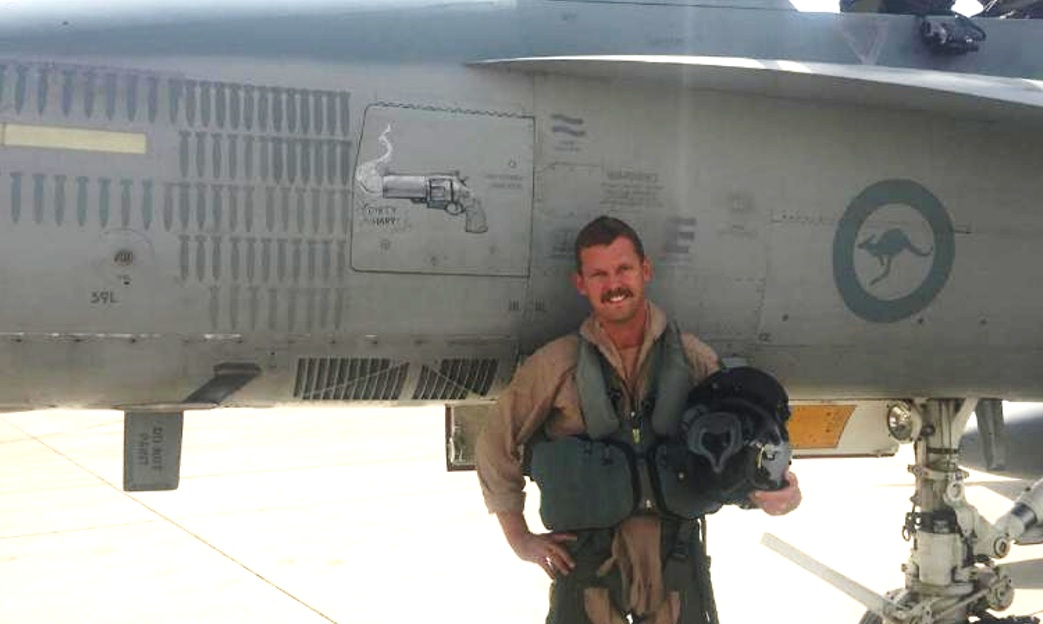
Marking TEN YEARS since 3SQN’s last “Hot War”, over Iraq/Syria.
The official caption to this photo reads: SQNLDR Ray 'Homer' SIMPSON, Executive
Officer of 3SQN, on Operation OKRA, in front of his F/A-18A
Classic Hornet [A20-46] featuring 'DIRTY HARRY' nose art,
hand drawn by Corporal Patrick KELLY - after Homer's strafe pass, the
first by a 3SQN aircraft since WW2.
3SQN provided two 3-monthly / half-squadron OKRA “rotations”
in 2016, the period noted in the RAAF History as, “The height of
operations against ISIL.”
Note the bomb-scoreboard to the left of the picture.
[NB. The ADF has forgotten 3SQN’s “Operation Firedog”
strafing with Sabres in the Malayan Emergency 1959/60.
- However, that campaign was indeed rather forgettable, as the
3SQN boys in their shiny new jets were essentially just strafing a
great big green thing called “The Malayan Jungle”! ]

Extract
from the recent book: “THE
CLASSIC”
(Hornet Aircraft in Australian Service),
by John QUAIFE
…Pilots
did not release weapons on every mission. Those who led the bomb
count were only averaging one bomb per mission, which meant aircraft
would often return with bombs onboard.
On
other occasions, the entire weapons load would be cleaned off the
aircraft. Some pilots were even called to strafe targets after
they had run out of bombs.
For
the gun to be effective, aircraft had to descend to much lower levels
and face exposure to small arms fire from the ground. This made
the whole risk-versus-reward equation a little problematic.
Over 38 months of OKRA operations, only eight Classic Hornet aircraft
made strafe attacks.
In
2016, Squadron Leader Ray SIMPSON was back in the Middle
East, this time as the Executive Officer of No.3 Squadron.
On one of the many missions he flew, Simpson was flying as ‘Number 2’
for a junior pilot who was building operational leadership experience
under the watchful eye of his very experienced wingman.
Holding
overhead Iraq's western desert, towards the Euphrates River, the pair of
Hornets were handed from Mischief Yankee [Operations Controller] to work
with a Special Operations JTAC [“Joint Terminal Attack Controller”]
near Haditha Dam, 120 kilometres northwest of Ramadi. On a radio
frequency sometimes difficult for the pilots to hear, the JTAC called a
target. It was a set of rocket rails adjacent to what
looked like a chicken shed.
- Unlike his experience using the old Nitehawk FLIR pod during
Operation Falconer, Simpson could clearly see the shed in full detail
and spotted the rocket rails.
Sitting
back as wingman, Simpson was essentially observing the action from the
best seat in the house. Wing Commander Jason EASTHOPE was
in the CAOC [Combined Air Operations Centre at Al Udeid Air Base,
Qatar] as the “red card holder” on duty, and the target looked ideal for
a GBU-54 (laser-and-GPS-guided) bomb.
As
they worked through their rapid attack-planning processes, Easthope
identified the adjacent building as a collateral damage concern.
Rather than employ a GBU-54, Easthope called for the rocket launcher to
be attacked with the aircraft's 20mm cannon. Simpson
realised he was about to execute his least-expected attack.
Although the aircraft were always loaded with 550 rounds (a
slightly-less-than-full gun-pack), the requirement to descend to lower
altitude to achieve the close range required for a successful
strafing attack meant they were seldom contemplated. However, the
accuracy of the weapon and the low yield of 20mm ammunition would
greatly reduce any prospect of collateral damage.
A
policy designed to create opportunities for junior aircrew was for wingmen
to always be the first to release weapons when a formation was
called for a task. Simpson still cops a ribbing from fellow
pilots, as this standard operating procedure put him, perhaps the most
experienced pilot in the Squadron at that time, into the box seat for
their first attack. Simpson agreed using the gun would solve the
collateral damage problem, but he harboured some doubts regarding what
effect his rounds would have.
Simpson's
junior Lead attempted his own follow-on attack, but was frustrated by
poor communication with the JTAC. Despite having a firing solution
and pressing a firing pass down to low altitude and into the range of
enemy small arms fire, the absence of a clearance from the JTAC meant he
could not fire, and the pass was aborted. The formation then
reached their ‘bingo’ fuel [minimum for safe return] and
were obliged to head to the tanker.
As
the 3SQN Executive Officer, Simpson impressed upon his fellow
pilots the importance of staying alert and ‘on the job’ until after
landing. Part of that guidance was to resist the temptation of
reviewing weapons video of their attacks during the return
transit...
- Sure enough, returning home over the North Arabian Gulf, Simpson succumbed
to temptation, but was able to conclude he was fairly happy with
what was recorded!
He
was right about the attention his attack would receive. Aircraft
A21-046 was quickly adorned with nose art depicting a particularly large
smoking handgun with the caption ‘Dirty Harry’, produced by No.3
Squadron artist-in-residence Leading Aircraftman Patrick ‘Patto’
KELLY, on the aircraft's gun-bay door.
3
Squadron RAAF STORIES
3 Squadron RAAF HOME /
Search

